Dienstag, 21. Januar 2025

The Petty „Kosmos“ of Witold Gombrowicz

It took me 35 years to read this book. It is short, only 144 pages in the edition I have*). But it was a slog.

(Warning: Spoilers, although there isn’t much of a plot to spoil.)

I bought the book in 1989 while in Cracow for a Polish language summer school during my university studies. I started reading it and then paused, because I had to look up so many words.

I’m generally able to go through Polish books at a reasonable speed. Knowledge of the subject and the development of the plot normally allow me to ignore individual words I don’t know.

But not here. In “Kosmos”, the first-person narrator builds a network of conclusions based on small, everyday objects and their perceived relations. Little details like cracks in the ceiling are important. Every word is important. So, if I don’t understand a specific word, I’ll miss a clue, a brick in the construction of the universe the narrator is constructing.

I resumed reading the book at later stages, read a couple of pages, and put it down again. Frankly, the universe in which the narrator moves isn’t very interesting – a house outside of Zakopane where the narrator takes summer lodgings together with an acquaintance called Fuks, and the household of his hosts, and towards the end a guest house in the mountains to which everyone plus some added friends and hangers-on make an excursion. The narrator becomes more and more unsympathetic and straightway creepy. (Need I say more than that at one point, driven by his own logic derived from all his clues, he strangles the cat of the host's daughter, a woman he feels sexually attracted to?) None of the personages were sufficiently intriguing that I wanted to spend time in their company, except for the host, the retired banker Pan Leon, whose idiosyncratic behavior was at least entertaining.

So I slogged through the book, putting it down, taking it up again, in the end forcing myself to read at least a paragraph every day, not because I found the book rewarding, but just to satisfy my inner completist.

Now I’m done, and I can’t even say it was worth it. The climax (ha!) of the book is old Pan Leon masturbating in front of an audience (they can’t see him doing it, but hear the sounds). A bit before, the narrator finds that Leon’s son-in-law has hanged himself – we don’t find out why, but we get a scene where the narrator plays around with the corpse. Then a torrential rain starts, washes all the smut away, we get a hurried ending in a couple of lines without any resolution, and that’s all, folks.

Gombrowicz can do better – I liked his “Opętani” (I read it in German translation – “Die Besessenen”), which plays with elements of thrillers and Gothic novels to tell an unlikely tale that is exciting both as a work of literature and as a story. I know “Kosmos” was designed as a more experimental novel, but does experimental mean that the author has to sacrifice captivating the reader? Except for a few pages with evocative descriptions of the environment in which the narration takes place, we mostly get to see the petty mind of the petty narrator trying to bring sense into a petty world. Maybe the world needed that at some point, but I didn’t, and I feel like I wasted my time with this book. Maybe it's me, I shouldn't have listened to my inner completist.


*) Witold Gombrowicz, „Kosmos“, Wydawnictwo Literackie, Kraków 1988


Montag, 13. Mai 2024

Salah Michel Bouraad, “Dieu est évidence“

 Éditions du Jubilé, 2006

This book by a Lebanese Christian layman who is both a successful businessman and deeply involved in charity in his home country has two main theses, which he develops across several chapters – 1) what the world needs most is love, and 2) love is both a gift from God and the best way to God. It’s a book written in a fluent, conversational style, easy to read; it’s not a systematic exposition, but it illuminates its theses from different angles in order to support them.

Concerning the first thesis, I found myself agreeing with many of the author’s examples and observations. On the second thesis, well, as I’m skeptical concerning the existence of God, I lack the basis for accepting the premise, but the author is graceful enough to appreciate if people embrace love without God; he hopes it will lead them to God in the end. For me, if reading this book makes some of its readers want to make this world a better place, it would already justify the labor of the author. If God exists, I hope he will see this the same way.


Freitag, 22. September 2023

Thoughts on Zinovyev’s “Zateya”

The book is a collection of satirical vignettes and thoughts about life in the Soviet Union, gathered into chapters with loose connections both within and between themselves. It looks like it was never finished by the author, so while the looseness is partially intended by the author, it’s also partially due to incompleteness and lack of clarity to the editors of which parts belonged where.

Reading the book thirty years after the end of the USSR, it doesn’t offer much that is new to anyone who is reasonably well-read on the Soviet Union. The most interesting part to me was not the satire, but Zinovyev’s thoughts about the Soviet system. He sees it as something not imposed on the Russian people from the side, by outside forces or a minority, but as something grown out of the character of the people itself, a system imposed by the people on itself. The system is due to moral degradation and causes further moral degradation. Abolishing the system won’t heal that; this can be only done by healing the moral degradation, by making people care about others more than their status and material well-being, by rejecting the temptation to use others for one’s own purposes and ignore their humanity and dignity.

This is a thought that I’ve seen showing up elsewhere; a person depicted as an example for such positive behavior is Viktor Maksimovich in Fazil Iskander’s “Stoyanka Cheloveka”. It’s certainly a sobering thought for someone like me who had hoped for a trajectory to improvement for Russia after the fall of Communism; seeing how the country now reverts to old patterns of behavior. We see the old patterns of collectivist behavior, of serving power and following the crowd for one own’s gain and in a misguide belief that this is the way to serve one’s country. It is now clear that Russia only did an incomplete reckoning with its past. I can only hope that it will free itself again, and won't miss out on the reckoning this time.

---

Александр Зиновьев, «Затея», Центрополиграф, Москва 2000


Dienstag, 4. April 2023

Philemon

 If anyone wondered who this poem was about, here he is:


Dienstag, 24. Januar 2023

An H.H.

Dem jungen Mann das Herze bricht,

Die holde Jungfer liebt ihn nicht.

Ein Ritter stirbt zur gleichen Stund,

Die Liebe schlug ihm rote Wund.

Zwei Brüder streiten tief im Tann,

Weil einer nur sie haben kann.

Der Jüngling sinkt ins kühle Grab

Und zieht Feinsliebchen mit hinab.

Nie enden Herzeleid und Tod,

Dem Dichter sind’s das täglich Brot.

Mittwoch, 15. Dezember 2021

Your hair is like a poem

Your hair is like a poem,

It flows from your crest,

It curls in a cadence.

It falls from your shoulders,

Its tiny feet dangling,

Dancing to the rhythm

Of your head moving,

Beating like gentle waves

Against the beach of your back.

Brushing across your face,

Opening,

Closing,

A curtain before a show,

A recital before a play,

Preparing the passion,

Announcing the drama,

Brush it away

And let me see.

Dienstag, 23. November 2021

Philemon

Philemon paws at the glass door, 
Answering what call? 
No cat no dog no bird to catch, 
Going against his own self? 
Up against the pane, 
Reared and aroused. 
Bring him a toy of fluffy felt 
And he’ll forget the mirror world, 
No lure no mates no more.

Mittwoch, 9. September 2020

Reading Shakespeare - Part I: The Comedies

Over the last couple of months, I’ve read the collected works of William Shakespeare. I don’t think that I can add any deep insights to the vast literature on the Bard, so I just give a quick personal judgment on all of them, in the order they are printed in my collection (“The Complete Works of William Shakespeare, Edited, with a Glossary, by W.J.Craig M.A., Trinity College, Dublin”; Reprint by Henry Pordes, London 1987.)

I will start with the comedies:

The Tempest

The “Tempest” left me disappointed – it’s a trite morality play, the characters left me cold. The only character I felt sympathy with is the savage Caliban, who had welcomed the shipwrecked Prospero and his daughter, then was subjugated by his magic, and is depicted as a monster to boot. I remember reading discussions of Caliban where his treatment is compared to that of indigenous people – cheated out of their homelands and then demonized when they don’t take it lying down. Caliban is no angel, but Prospero would have been more in his right to punish him for assaulting Miranda if he hadn’t enslaved him before. As in many of the following plays, the most entertaining part is the banter of the lower class people, here the sailors and servants.

The Two Gentleman of Verona

An unbelievable plot with cardboard characters and wafer-thin psychological motivation. Again, the only saving grace are the banter and the monologues of the servants.

The Merry Wives of Windsor

A really funny comedy. Not really original or psychologically deep, but well executed and full of wordplay, even if some aspects (“foreign accents are funny”) may not cater to more refined tastes nowadays.

Measure for Measure

The plot and plot twists are very construed, but it has some interesting thoughts on justice and sin. The sense of justice and the reasoning partially seem alien from today’s point of view. E.g., almost everybody accepts that sex out of wedlock is a crime, even worthy of death, and only argues that either punishing it is impractical because too many people are guilty of it, or asks for forgiveness because even those who punish for it are subject to sin. No-one comes up with what would be the main arguments today, that sex out of wedlock shouldn’t be punished at all or that the death penalty is much too harsh. On the whole, it doesn’t really work for me – the comedic parts distract from the serious issues.

The Comedy of Errors

I don’t especially like comedies of mistaken identity, but I imagine that this one can be funny on the scene if played well. As I just read it, I didn’t find it really funny. The only psychologically interesting part was where her supposed husband’s strange behavior fueled Adriana’s jealousy.

Much Ado About Nothing

Again a comedy that is saved mostly by the banter. Neither the “tragic” plot (Hero’s slander and rehabilitation), nor the “comedic” plot (Beatrice and Benedick being duped into loving each other) really work. That’s not astonishing for the tragic plot, because the tragic plots tend to be cardboard-flimsy in other Shakespearian comedies as well, but also the change for both Benedick and Beatrice from being convinced bachelors to loving each other just by being told that the other one is secretly desperately in love with them is not convincing at all.

Love’s Labour’s Lost

This one doesn’t even have got much of a plot, and it’s the better for it. Lots of banter, puns, and comic relief.

A Midsummer Night’s Dream

I liked this one – a fluffy comedy with lots of wordplay and banter, and it has really funny moments – Bottom in fairyland, the bitch fight between Helena and Hermia, the audience panning the artisans’ play. The invocation of fairy magic also makes the plot about erring love and subsequent reconciliation believable. Both Helena feeling mocked by suddenly being the object of declarations of love by two men, and Hermia’s despair at her love abandoning her add some depth to the play.

The Merchant of Venice

This play has three plots that seem welded together. One of them is a morality play – the choice of boxes demanded from Portia’s suitors. The second is light comedy - Portia and Nerissa testing the faith of their fiancés. The third and central plot, Shylock trying and failing to get his revenge on Antonio, is the most serious and quite tragic.  The tragic figure is Shylock, who despite his riches loses control of his daughter and has to suffer from prejudice against his religion and from contempt for taking interest, even though the credit he provides is part of the basis for the ventures of the Christian merchants who despise him. And, as often with the oppressed, when he sees a chance for revenge, he overshoots and then is brought down by a system that is rigged against him. His demand for Antonio’s flesh is cruel and inhumane, but Shakespeare shows very well that this cruelty has its roots in the behavior of those who mercilessly mocked and abused Shylock, and suddenly plead for and demand mercy when the sharp end is pointed at them. This central plot and its execution make the play a masterpiece.

As You Like It

This play is a bit like a salad – several subplots have been mixed in a bowl, and none of them, by themselves, is very convincing or original. The villains are cardboard, and the resolutions are mostly dei ex machina – a brother’s hatred is converted to love by the other brother saving him from a conveniently arisen danger, another villain is converted to virtue by a conveniently met holy man, and both conversions happen off-stage and are just related by narrators in the play. Some scenes and characters look bolted on, as if they were meant to play a bigger role and were cut short, but forgotten to be totally taken out – an example are the scenes with Oliver Martext and William, and in general it seems to me that Touchstone’s wooing of Audrey is just a remnant of what was a bigger subplot. Nevertheless, the play has a nice cast of funny characters and a sufficient amount of witty dialogue, so it looks like it would be fun to watch.

The Taming of the Shrew

I can’t see how this play can still be played as a straight comedy nowadays. It’s quite witty, and has many funny scenes, and in this piece, even the mistaken identities make sense. But the central idea, that women need to be subservient to men and that using psychological bullying in order to subdue them is clever and to be applauded, this is an idea that today would be shared only by very misogynistic or reactionary persons. Here, Shakespeare is just a man of his times, and he isn’t even able to show Katharina the degree of understanding that he shows for Shylock in the “Merchant”. Therefor I can read it only as a document of a worldview that I don’t share, but not enjoy it as a comedy.

Another thing is the framing plot about a Lord playing with poor drunkard, making him believe that the drunkard is really a Lord who had lost his mind, having the taming of the shrew staged as a play for him to watch, and then sending him back to his life as a poor drunk again. While it is known that Shakespeare found that framing plot in a previous version of the play by another author that he re-wrote, it’s not clear how much of the framing plot was actually included when the play was staged at the Globe Theatre.  It can be read as a kind of commentary, because this is also about someone (the Lord) using his power to abuse someone less powerful, even though less damage is inflicted.

All’s Well That Ends Well

My German Shakespeare edition that I’m reading in parallel calls this “not so much a comedy as a drama with a happy ending”. That’s quite a fitting description, depending on what you call “happy”. Is it a happy ending if the girl gets the boy she wants, but the boy is a jerk? The young Count Bertram may be a valiant soldier, but he’s not only full of class conceit – which would be understandable to a degree for a man of his time and rank -, he also forgets his vows to a woman he swore to love, and slanders her when she holds him to his vows. He tells lies when he’s found out. And I can’t shake the feeling that the love he says he’s developed for Helena after her supposed death is only show for the sake of his mother and the king, whom he wants to please. (He also doesn’t love cats, which is a sure mark of a bad character.) With all this, I can’t understand why Helena still wants him after all she’s endured and witnessed from him; love surely makes blind.

Despite these misgivings, I liked the play, which has a relatively straightforward plot that is not driven mostly by accidents and dei ex machina, like many other of the comedies, but by the actions and personalities of the main characters, who also are interesting and not just cardboard. There also are comedic elements, like the scenes with the fool of the Countess of Roussillon, and the plot around the exposure of the boastful but cowardly Captain Parolles.

Twelfth-Night, or What you Will

A light but entertaining comedy of errors, with main female protagonists fleshed out enough that one cares for them. It also has a funny sub-plot about a pompous, self-important servant who is played for a fool.

The Winter’s Tale

Like “All’s Well”, this is more of a drama with a happy ending, than a full comedy. King Leontes’s jealousy, which causes the chain of events depicted, is well executed. King Polixenes’s rejection of his son’s courtship for Perdita has a certain irony – he is ruining the relationship with his son, and risks losing him, in a similar manner like Leontes ruined his friendship with him and lost his wife and children. The reconciliation and Hermione’s “resurrection” are too melodramatic for my taste. The comedic elements, especially Autolycus’s mischief, don’t really fit – it looks like Shakespeare tried to mix up a piece to please everybody.

Sonntag, 5. April 2020

Alexander Osang: „Die Leben der Elena Silber“


S. Fischer, 2019, 617 S.

Der Roman beschreibt die bewegte Lebensgeschichte von Elena Silber, im vorrevolutionären Russland geboren und kurz vor Ende des Sozialismus in der DDR gestorben, sowie die Versuche ihres Enkels Konstantin Stein, die ungelösten Fragen in ihrer und seiner Familiengeschichte aufzuklären. Elena Silber wird Anfang des 20. Jahrhunderts geboren; ihr Vater, Anhänger der Sozialisten, wird 1905 von einem reaktionären Mob getötet. Damit beginnt eine Geschichte von Vertreibung, Flucht und Suche nach besseren Lebensmöglichkeiten. Elena heiratet einen deutschen Ingenieur und landet dadurch in NS-Deutschland; nach dem Krieg bleibt sie in Berlin hängen, wo sie 1982 stirbt. Ihr Enkel Konstantin, Anfang vierzig, geschieden, Filmemacher, wird von seiner dominanten Mutter (einer von Elenas fünf Töchtern) dazu bewegt, Elenas Lebensgeschichte zu erforschen, in dem es ungelöste Widersprüche gibt, besonders um das Verschwinden ihres Mannes nach Kriegsende. Laut Klappentext wurde der Roman von der Familiengeschichte seines Verfassers inspiriert.

Der Roman wird mit vielen Rückblenden mal aus der Sicht Elenas, mal aus der Sicht Konstantins erzählt. Abgesehen von den Rückblenden ist der Erzählstil geradlinig und gut lesbar. An vielen Stellen, besonders wenn aus der Sicht von Konstantin geschrieben, wird sie vom Dialog vorangetrieben. Die Stellen aus Elenas Sicht wirken oft distanziert, wie angelesen, und Elenas Persönlichkeit bleibt fern und verschwommen. Das trifft vor allem auf die Stellen zu, die ihr Leben in Russland beschreiben, während ihr Leben in Schlesien kurz vor und nach Kriegsende und die Jahre in Berlin lebendiger beschrieben ist, so, als wenn die größere geografische Nähe auch eine größere Nähe zur Person bewirkt. Konstantin dagegen und seine Welt gewinnen ein sehr viel klareres Profil; man merkt, dass der Verfasser die Welt, die er beschreibt – Konstantins Kindheit, die dominante Mutter, die Demenz des Vaters, die Beziehung zum Sohn aus der geschiedenen Ehe, die verschiedenen Ostberliner Milieus, in denen Konstantin sich bewegt – gut kennt.

Insgesamt ein gut lesbares Buch. Die russischen Elemente bieten eine gewisse Exotik, aber wirken oberflächlich auf jemanden, der eine gewisse Vertrautheit mit Russland mitbringt. Interessanter ist es als Teil eines großen Mosaiks, als ein weiterer Blick auf vertraute Fragen – was bedeutet Familie, wie gehen Menschen mit Beziehungen um, in welchen Formen suchen sie nach Nähe und Distanz, nach Liebe, Anerkennung, wo ist Heimat, was für Geschichten erzählen sie sich selbst und anderen. Dieser Roman ist ein weiteres Steinchen in diesem Mosaik, und dabei ein unterhaltsames, auch wenn nie wirklich aufgeklärt wird, was aus den verschwundenen Männern in der Familie der Silbers geworden ist.

Sonntag, 1. Dezember 2019

Gecko


Gecko

Gecko is good.
Gecko eats insects.
Keeps the house clean.
Walks on the wall.
Sits on the ceiling,
Smacks and snacks.
Chirps like a bird,
Upside down.
Hides under the sink,
Feeds on junk.
Don't live on junk,
Stay good, stay useful.
Don't junk the bonds
That bind, that save us.
Now you're inside,
You'll end up outside,
Down from the wall,
Splat on the street,
Caught by the movement,
Unpredictable, unforeseen,
When what goes up
Comes crashing down,
Crushing,
Squishing.
Don't live your greed,
Stay good, stay humble,
Catch flies and gnats,
Catch bugs and roaches,
Live with us,
Not off us.
Gecko stay good.


Dienstag, 31. Juli 2018

Ein Buch über CO2

Here again - I don't think that anyone who doesn't read German will be interested in a German introductory overview on the role of CO2 in climate change, so the review is in German.

Ewald Weber: "Welt am Abgrund. Wie CO2 unser Leben verändert", Darmstadt 2018 (WBG), 207 S.

Das vorliegende Buch ist eine Einführung in die Rolle von CO2 beim Klimawandel. Die Kapitel 1 - 4 beschreiben was CO2 ist, seine Quellen und die Mechanismen des Treibhauseffekts. Kapitel 5 - 11 stellen die Folgen für Weltklima, Natur und Menschen dar. Kapitel 12 - 15 beschreiben die Möglichkeiten, die Folgen zu vermeiden - technische Lösungen zur Entfernung von CO2 aus der Athmosphäre und Lagerungsmöglichkeiten, Maßnahmen, die es der Natur erleichtern, CO2 zu verarbeiten (z. B. Aufforstung) und Vermeidung. Das Buch kommt zum Schluss, dass die anderen Maßnahmen helfen können, aber nur wesentliche Verringerung von CO2 - Ausstoß die Folgen wirksam verhindern kann.
Trotz des dramatischen Titels ist das Buch in einem sachlichen Ton geschrieben und gibt einen guten Überblick über das Thema. Für Menschen, die sich schon intensiv mit der Erderwärmung befasst haben, bietet es nichts neues und die Schlussfolgerungen des Autors entsprechen dem gegenwärtigen Konsens, wie er sich zum Beispiel auf den Klimakonferenzen beobachten lässt. Das Buch ist daher am Besten geeignet für Menschen, die dem Thema Klimawandel bisher nur oberflächlich oder ausschnittsweise in den Medien begegnet sind und sich besser informieren wollen. Das Buch enthält auch eine Bibliographie, anhand derer interessierte Leser tiefer in einzelne Aspekte einsteigen können.

Dienstag, 14. November 2017

Sonntag, 27. August 2017

Andreas Paul, "Von Affen und Menschen"

Reposted Goodreads Review:
Ein sehr guter Überblick über die Forschung zum Verhalten der Primaten (einschließlich von uns Menschen) und über verschiedene evolutionstheoretische Erklärungen. Sehr positiv ist, dass der Autor immer klar anzeigt, inwiefern Ergebnisse und Erklärungen durch Beobachtungen und Experimente gestützt sind. Das Buch ist verständlich und lebendig geschrieben.
---
A very good overview over the state of research on primate behaviour (including us humans) and over the various evolution based explanantions. It's very positive that the author always indicates clearly how far results and explanations are based on observations and experiments. The book is written in a comprehensible and lively language.

Sonntag, 23. Juli 2017

Norbert Wolf "Malerei Verstehen"

This is a re-posting of my Goodreads Review. The review is in German - I assume most pepople interested in a German introduction to painting are more likely to read German than English.
Это - краткая рецензия немецкой  книги - введения в живопись. Так как я предполагаю, что человек, заинтересованный читать такую книгу, знает немецкий язык, данная рецензия - на немецком. 
Das Buch ist eine Einführung in die Malerei, nach Sachgebieten geordnet (Farben, Farbe contra Zeichnung, Prozess des Malens, Gliederung der Bildfläche, Malerei und Raum, Bildgattungen, Malerei und Gesellschaft, Malerei zwischen Illustration und Abstraktion). Leider werden viele Themen nur sehr kurz angerissen (z. B. Farben, Maltechniken) - der Autor zählt ein paar Schlagworte auf, ohne zu erklären, was sie bedeuten. Es enthält auch zu wenig Illustrationen -  so wird eine Wandmalerei von Matisse über zwei Seiten hinweg diskutiert, aber es gibt keine Abbildung im Buch.
Teilweise sind zwar Illustrationen vorhanden, so werden z. B. die Fresken Giottos in der Arenakapelle in der Gesamtansicht gezeigt (Abbildung Nr. 15), so dass sehr schön die Einordnung der Fresken in den Raum zu erkennen ist. Aber Wolf diskutiert auf S. 89 auch die Komposition eines Ausschnitts aus dem Fresko, der auf der Abbildung nicht erkennbar ist.
Manche Themen, wie "Malerei und Gesellschaft", leiden weniger darunter. Aber um den Anspruch des Buchs zu erfüllen (Klappentext: "Ob Kunstkritik, Vernissage oder Museumsbesuch: Mit 'Malerei Verstehen' ist man immer gut vorbereitet"), wären detailliertere Erläuterungen und mehr anschauliche Illustrationen notwendig gewesen.

Freitag, 30. Juni 2017

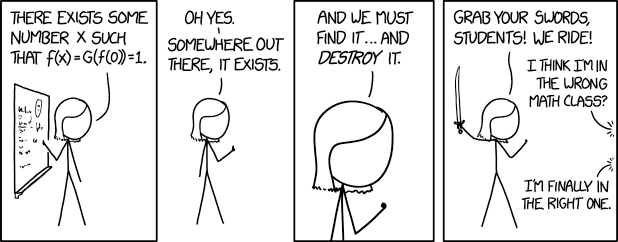
Рубить!

As I've recently been reading a lot of Babel, I just had to think that's how the Red Cavalry would have approached maths.
В последнее время я читал много Бабеля, и увидев это, я подумал что вот так конармия бы решила математические проблемы.


Ich habe in der letzten Zeit wohl zu viel Babel gelesen. Jedenfalls ist mir hierzu als erstes eingefallen, dass dies die Art sein muss, wie die Reiterarmee mathematische Probleme löst.

Samstag, 3. September 2016

A Clockwork Clocked

I had put off reading "A Clockwork Orange" for a long time. It's a book that has become part of common cultural knowledge, and the things I knew about it - the ultraviolence, the nadsat slang - didn't really entice me to read it. That despite the fact that I liked what else I've read by Burgess - "One Hand Clapping" is a very funny read, and "Language Made Plain" is the one book I'd recommend for a popular introduction into the history and workings of the English language.

But then my daughter left her edition of "Clockwork" behind when she went off to study recently, and I started reading. And I didn't put it down - well, almost, I interrupted reading maybe once or twice.

It turns out that the ultraviolence, while taking up a substantial part of the book, is described not too gorily, and then we're probably nowadays too used to graphically described violence - the book contains less blood and gore than the average episode of Game of Thrones. And the violence is not gratuitous, but again, it's a well-known fact that good and evil and the role of choice betwen them are central topics of the book.
The nadsat - a slang containing a large part of Russian - was also less of a hindrance to understanding than I had assumed. As I speak Russian reasonably well, some of it grated and felt unnatural; gloopy for "stupid" sounds natural, but a lot of the loaned verbs didn't look like natural candidates for loaning and their English adaptations feel forced. But on the whole, it gives the book its very own flavour. Some of the words escaped me for quite some time, simply because the adaptations in English don't sound much like their Russian originals. I only understood in the middle of the book that horrorshow is Russian хорошо, and even more embarrassingly, it took me until the last pages to get that lewdies "people" is not derived from lewd, but Russian люди.

Now you ask, this is all faint praise or no praise at all, so what kept me hooked? It's the voice, the language, the way Alex (the first-person-narrator) talks.  It's enchanting, taking you along on the ride, making you want to find out more about the character. He has a great lot of negative traits and for his actions he'd deserve contempt or hate, and in the chapters after his treatment he's quite pathetic, but still the narrating voice is like a tasty drink that I couldn't put down. The only other narrator who can capture me like that is Isaak Babel, who also knows how to tell horrible tales with a voice that you don't want to stop listening to.

And despite the fact that the book's content has become a part of popular culture, the ending still was surprising.

Freitag, 25. September 2015

Colours of the Past

A great post at Poemas del Río Wang about colour photos shot by Sergey Mikhaylovich Prokudin-Gorsky in imperial Russia before the First World War. I didn't know that colour photgraphy did even exist back then, all I had seen from that period were originally black-and-white photographs that have been coloured by hand. These photographs make the time look so much nearer and closer! Thinking of that period, I would normally have Sepia toned images in my head, or maybe simple black-and white, but these photographs have the look and feel of photographs taken in the 1950 or 60s, like the slides of trips across Germany and Italy that my father used to show to us.
The surviving collection can be found at the U.S. library of congress.

Dienstag, 1. September 2015

One man, one vote

Well, it's one woman, one vote, and it's a funny story.

Freitag, 17. Juli 2015

Evgenij Primakov R.I.P

I'm sure nobody is getting their news from my almost-never updating blog, but as I've reviewed one of his books, I may as well report on his death, on June 29th, 2015. Here's a link to his obituary at the Economist, which sums up his life quite well. Да будет земля ему пухом.

Samstag, 10. Januar 2015

Decorative Hegel

Another webcomic link. But it's about philosophy, so that's OK.

Nisi aperuisses librum, quasi discipulus Hegeli fuisses.